The Edwardian Roller-Skating Craze
The Edwardian “rinking” craze of roughly 1908–1912 was certainly felt in Rusholme.
Roller-skating was sweeping across Britain, and skating rinks were opening in towns and cities throughout the country, including London, Birmingham, Leeds, Liverpool, Brighton, Harrogate and Scarborough. By 1910 there were said to be more than 500 roller-skating rinks in Britain. The largest, the Empress Rink at Earls Court, could accommodate around 4,200 skaters.
The new industry was considerable. It employed some 17,000 people, including box-office staff, skating instructors and musicians who provided the live music that accompanied the skaters. Roller-skating even had its own specialist press, with monthly and weekly magazines such as The World of Wheels and Roller Skating Records.
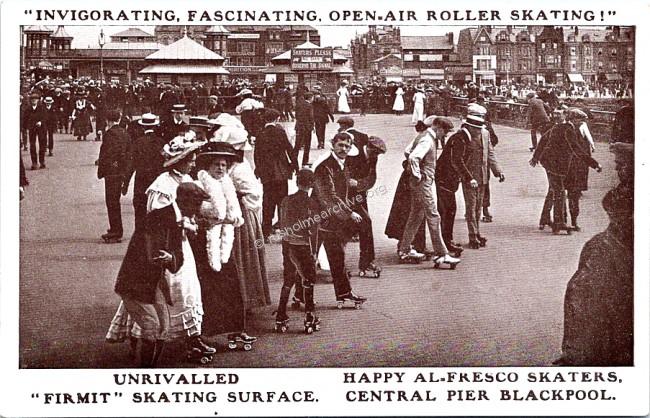
But “rinking” was about much more than simply skating. It was an important social activity, particularly for young men and women. There were skating clubs, competitions, professional performers, orchestras and organised social events. Women could participate as serious skaters as well as for recreation, and skating became associated with fashionable leisurewear. Contemporary images show women skating in elaborate Edwardian hats, skirts and coats—and sometimes even fur. Not all of ‘Rinking’ was indoors, the postcard below from Blackpool and showing ‘Happy Al-Fresco Skaters’ .
A postcard comes home to Rusholme
I found the picture postcard below on eBay. It had been offered by a dealer in New York, so I was particularly pleased to have it shipped back to Rusholme.
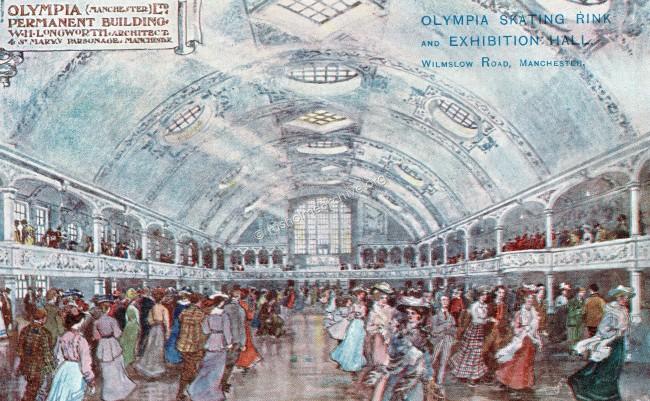
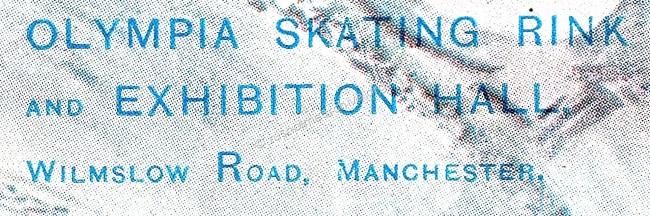
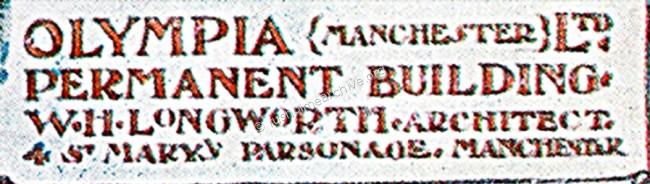
The Olympia Skating Rink was built on the corner of Wilmslow Road and Rusholme Place. The architect was the Manchester architect Harry Longworth.
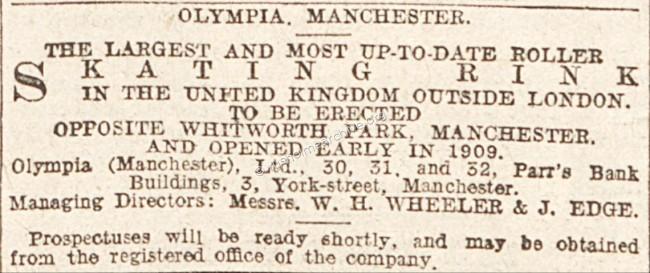
The first evidence I have found of the proposed rink appeared in the Manchester Evening News on 30 January 1909. An announcement stated that the largest and most up-to-date roller-skating rink outside London was to be erected opposite Whitworth Park. The announcement also stated:
“Prospectuses will be ready shortly and may be obtained from the registered office of the company.”
The prospectus duly appeared on 13 February 1909.
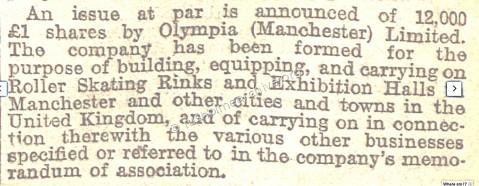
The proposed investment was substantial. The cost of the project was £12,000, a very considerable sum in 1909.
For comparison, the website Measuring Worth gives a number of different ways of expressing the equivalent value today. Depending upon the measure used, £12,000 in 1909 could represent anything from approximately £1.76 million by an inflation-based calculation to considerably more—potentially as much as £17.8 million—using other measures of economic value. The precise modern equivalent is less important than the fact that this was a substantial commercial undertaking.
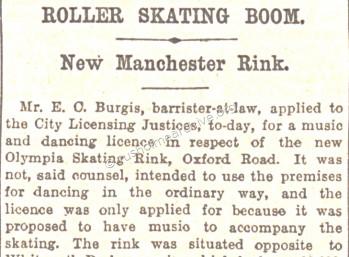
On the 4th March 1909 the Manchester Evening News carried an interesting report about an application for a licence for music and dancing – one of the magistrates expressed concern about the risk of injury!
A complete leisure experience
By 24 March 1909, the Manchester Evening News was advertising the rink and giving an indication of both the range of facilities and the cost of admission.
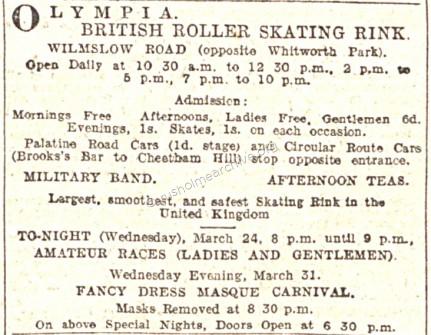
The Olympia was clearly intended to offer much more than somewhere simply to hire a pair of skates. It was part of the rapidly developing commercial world of organised leisure, in which skating, music, socialising and fashionable entertainment all came together.
Barely two weeks later, on 3 April, another notice in the Manchester Evening News offered:
“Instructions at moderate charges by special experts, mornings and afternoon only.”
The arrival of professional instruction is interesting. Skating was not necessarily something that everyone could simply do immediately, and the ability to skate proficiently had itself become a marketable skill.
There was, however, another industry that developed alongside the skating rinks: the picture postcard.
The postcard below was one of several versions produced in 1909 using professional models to portray the antics of roller skating at the rink.
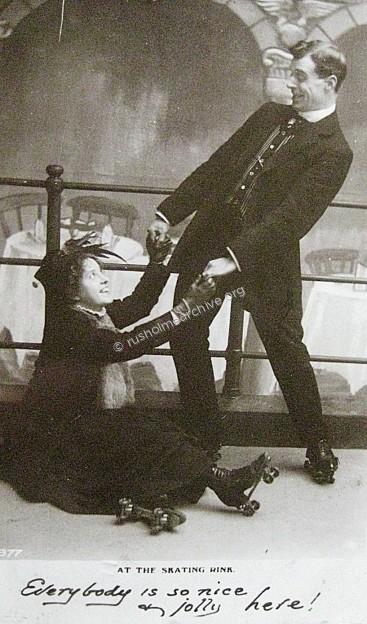
The quotation on the postcard is presumably spoken by the young woman being helped to her feet: “Everyone is so nice and jolly here.”
Another postcard carries a rather more practical warning under the heading, Hints to Skaters. “Don’t stop too suddenly, it’s dangerous.”
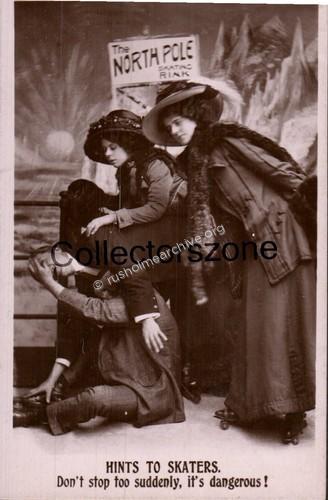
Other cards concentrated on the more romantic side of skating.
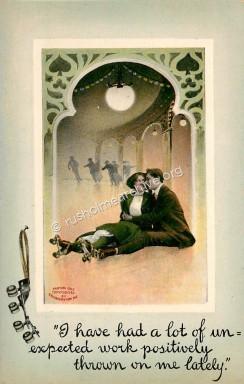
Some of these images perhaps tell us as much about how skating was being marketed as they do about what actually happened on the rink. The young, fashionable and slightly flirtatious image of roller skating was clearly part of its appeal.
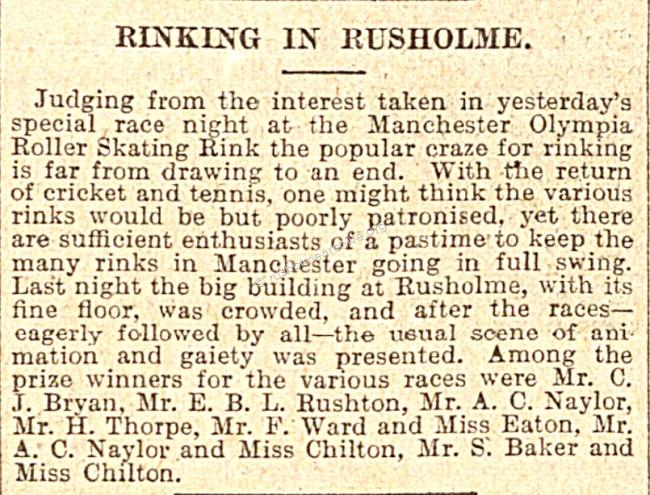
The Manchester Courier also reported on the Olympia. The following extract is from 20 May 1909.
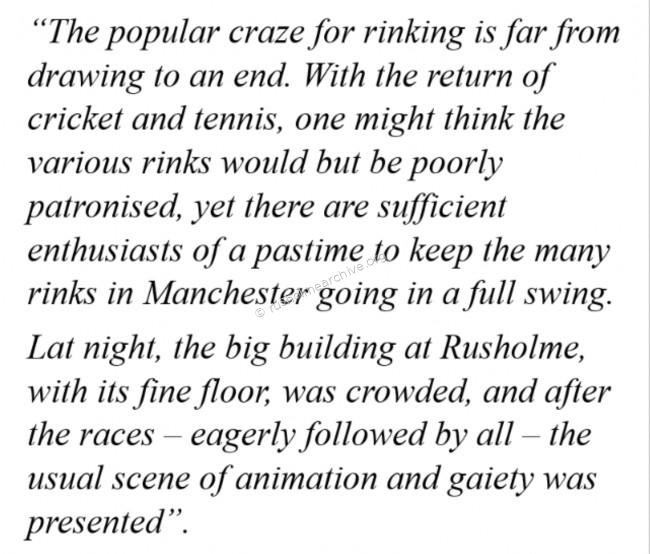
The complete newspaper note is reproduced below the extract.
By this point it is clear that the Olympia was firmly established within the rapidly expanding local skating scene.
Indeed, only a few months after the April advertisement, I found a fascinating listing in the Manchester Evening News of 14 October 1909. Seven roller-skating rinks were listed.
Among them were the Imperial in nearby Ardwick and, even closer to Rusholme, the College Rink at the University.
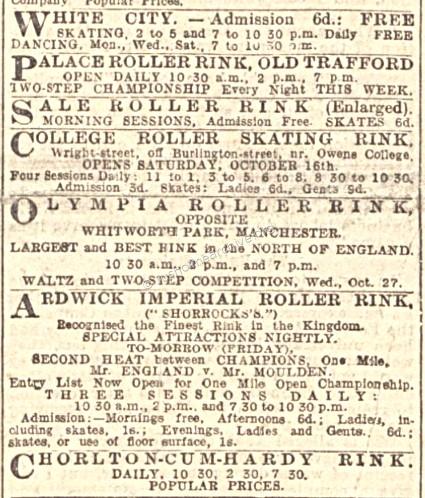
The appearance of seven rinks in the same newspaper is a useful indication of just how rapidly the craze had developed. What had begun as a new form of fashionable entertainment was becoming a competitive business.
Rinking and the cost of leisure
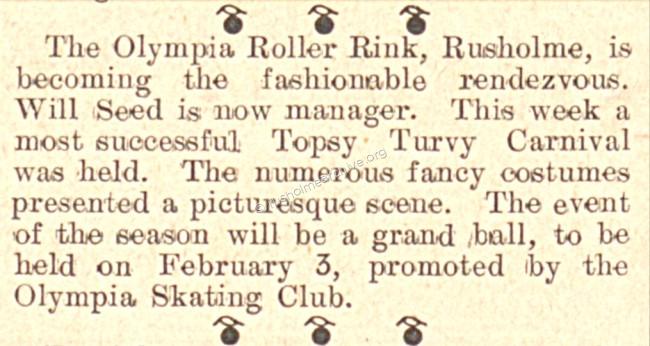
A review in the Music Hall and Theatre Review dated 26 January 1911 provides another glimpse of the skating world.
Page still under construction.